Blog Archive

Showing posts with label rocks. Show all posts

Wednesday, August 5, 2026

Tabular Barite Crystal Specimens and the Heavy World of Barite Rocks and Minerals

Many minerals are prized by geologists, miners, and collectors, but barite stands out because of this unusual property: its weight. 

A piece of barite often feels unexpectedly heavy in your hand.  It's much denser than most rocks of similar size. This characteristic is what gave the mineral its name.  Barite is derived from the Greek word barys, meaning “heavy.”

barite crystal rock specimen with cerussite and galena
Barite Crystals with Cerussite and Galena

Chemically, barite is barium sulfate (BaSO₄). It owes its heaviness, or density, to the element barium, which has a much higher atomic weight than the silicon, aluminum, and calcium found in many common minerals. When these heavy barium atoms are packed into barite’s crystal structure, it results in one of the densest common (nonmetallic) minerals on Earth.

Barite forms in a wide range of geological environments.  Because of that, it develops in many different shapes and textures. The most famous among collectors is tabular barite, where crystals grow as flat rectangular blades stacked together in cool dramatic arrangements. 

These specimens can resemble stacked books, flower petals, or some people say frozen wings. Colors range from honey yellow and blue to white, gray, and reddish brown, depending on impurities and growth conditions.

tabular barite crystal specimen held in front of green plant leaves
Tabular Pink to Brown Barite

The tabular crystals forms because of barite’s structure. It has what's called an orthorhombic crystal structure, where three axes meet at 90 degree angles, but as crystals grow, some crystal faces expand faster than others, producing broad flat blades instead of blocky forms. Slow crystal growth in open cavities is especially important. 

In hydrothermal veins deep underground, mineral-rich hot fluids circulate through fractures and cavities while carrying dissolved barium and sulfur. As the fluids cool or pressure changes, barite (like many minerals) precipitates from solution. When the process happens slowly and steadily, sharply formed tabular crystals can develop.

brown barite rock specimens wrapped in padding
Brown Barite Crystal Specimens

Hydrothermal systems are responsible for many of the world’s finest crystal specimens. In Morocco, mineral-rich veins associated with lead and zinc deposits have produced spectacularly beautiful golden tabular barites that are highly sought after by collectors. China is also famous for blue and amber-colored crystals, often found near fluorite and calcite.

Fibrous barite forms another distinct variety. In narrow fractures where crystals grow rapidly in parallel directions, the mineral develops silky, threadlike textures. Some fibrous specimens resemble satin spar gypsum, though they too are much heavier.

Rosette barite (desert roses) is especially famous. In these formations, crystals radiate outward in flowerlike clusters. Sand grains get trapped inside the growing crystals, creating beautiful rose-shaped structures in arid sedimentary environments where mineral-rich groundwater evaporates.

Barite also forms nodules and concretions within sedimentary rocks. In these settings, barium-rich fluids move through buried sediments and precipitate barite around fossils, organic material, or other nuclei. Some nodules become surprisingly large and extremely dense.

the many uses of barite in construction, medical industry, and mining
Industrial Uses of Barite

However, most barite found in nature doesn't occur as beautiful tabular crystals. Massive barite is far more common and is used for a lot of world’s industrial barite production. These dense, compact deposits may fill veins, replace surrounding rock, or occur as large sedimentary beds. Massive barite is often white, gray, tan, or brown and can resemble limestone.  If you pick it up, it's just as heavy though. 

The majority is used in industrial applications.  Much is ground into powder and used in drilling mud for oil and gas exploration. Because the mineral is so dense and chemically stable, it helps control underground pressure during drilling and reduces the risk of blowouts.  In the medical field, barium sulfate suspensions are used in some imaging procedures because it blocks radiation effectively.  In construction and engineering, barite is added to radiation-shielding concrete used in hospitals and nuclear facilities. Smaller amounts appear in paints, plastics, rubber, and industrial fillers.

Heavy Barite Crystal Specimen in Hand

What makes barite so fascinating is the contrast between elegance and practicality. The same mineral that forms delicate blades in underground cavities is also a critical industrial material used in oil wells, medical imaging, and radiation shielding. Whether it appears as tabular crystals, desert roses, fibrous veins, or dense sedimentary masses, barite is a great example to learn about the diversity and wonder of geology.

Head on over to the shop and pick up a beautiful barite crystal specimen to add to your rock collection!


Thursday, July 24, 2025

5 Rock Specimens You Need in Your Collection Right Now

Whether you're a seasoned mineral collector, a geology student, or someone who's just recently fallen in love with the Earth’s hidden treasures, your collection isn’t complete without a few standout specimens. Some rocks and minerals go beyond beauty; they’re conversation starters, rare finds, and textbook examples of natural perfection. Here are five rock specimens you need now!


1. Wulfenite:  The Gem of the Lead Mines

Color: Bright orange to reddish-orange, sometimes yellow
Location Highlights: Arizona (USA), Mexico, Morocco
Why You Need It:
Wulfenite is the showstopper of any rock cabinet. Its razor-thin, tabular crystals shimmer like glass and come in vivid colors, especially bright orange. This lead molybdate mineral forms in oxidized lead deposits and is often associated with other eye-catching minerals like vanadinite.
Whether you're into collecting for the aesthetics or the science, wulfenite delivers on both fronts. Its delicate crystals require careful handling, but the reward is a fiery mineral that looks like it's glowing from within.


Beautiful Green Wavellite Rock Specimen from Arkansas


2. Wavellite:  The Radiating Beauty

Color: Apple green, yellowish-green, white
Location Highlights: Arkansas (USA), Cornwall (UK), Czech Republic
Why You Need It:
Wavellite isn’t just fun to say, it’s a visual masterpiece. Known for its unique radiating spheres that look like mineral fireworks, this hydrous aluminum phosphate is often overlooked, but once seen in person, it's unforgettable.
Collectors prize wavellite for its unusual formation and subtle glow under certain lighting. Plus, it’s a fantastic teaching specimen for understanding radial crystal growth and phosphate minerals.


Purple Fluorite from Cave In Rock, Illinois; a fluorescent mineral
Purple Fluorite from Cave In Rock, Illinois

3. Fluorite: The Multi-Colored Wonder

Color: Every color of the rainbow (often purple, green, blue)
Location Highlights: Illinois (USA), China, UK
Why You Need It:
Fluorite is the chameleon of the mineral world. It forms in a cubic crystal habit and can exhibit strong fluorescence under UV light, hence the term "fluorescence" comes from fluorite itself. Some specimens even show color zoning and phosphorescence.
No collection is complete without a fluorite specimen or two, especially one from the famed Illinois Fluorspar District. It’s the perfect combo of science and aesthetic.


Malachite Copper Ore Rock Specimen from Arizona, Planet Mine
Malachite Copper Ore from Arizona

4. Copper Carbonates:  The Green and Blue Icons

Color: Deep green (malachite), royal blue (azurite)
Location Highlights: Democratic Republic of the Congo, Arizona (USA), Morocco
Why You Need It:
Copper carbonate minerals like malachite and azurite are legendary in the rock world for their vibrant color and striking textures. Malachite dazzles with its rich green bands and botryoidal formations, while azurite stuns with deep blue crystals and earthy nodules. These two minerals often grow together, forming surreal blue-green combinations that are collector gold.

Aside from their beauty, copper carbonates are historically significant.  They’ve been used as pigments, ornaments, and even early indicators of copper ore for mining. Whether you prefer the silky swirl of malachite or the crystalline pop of azurite, copper carbonate minerals are a must-have cornerstone for any collection.


Gemmy and sparkly blue Veszelyite mineral specimen in a perky box
Gemmy and Sparkly Blue Veszelyite Specimen

5. Veszelyite:  The Rare Blue Beauty

Color: Intense blue to blue-green
Location Highlights: Namibia, Bulgaria, USA (Montana)
Why You Need It:
Veszelyite is a collector’s dream:  striking in color and rare in availability. This secondary copper and zinc phosphate mineral forms in vivid, almost neon blue hues that rival even the finest azurite. Its sharply defined, small but lustrous crystals are most often found in association with other secondary minerals in oxidized zones.
Because of its scarcity and stunning appearance, veszelyite is a high-value specimen that stands out in any collection. If you find one with well-formed crystals, consider it a top-tier prize.


How to Shop Smart

  1. Confirm authenticity:  Check that specimens are clearly labeled and have good photos.

  2. Size vs. price:  Price varies widely by mineral specimen, but generally you can expect larger minerals to cost more than smaller minerals.  An extremely low price may simply indicate a motivated seller.  However, it may also be a red flag, as fake minerals are often sold cheaper than real natural ones.  

  3. Trust reputable sellers:  Verified Etsy shops, established mineral dealers, and sellers with clear policies are safer bets.

  4. Watch for shipping:  Minerals can be fragile; look for notes on how a shop ships their specimens, or other customer reviews mentioning secure packaging.  Most reputable mineral dealers understand this, and always do their best to ensure their specimens arrive safely.  They are in business because they like rocks as much as you do!


Rock and Mineral Display Gear You’ll Want

No mineral collection is complete without the right way to show it off. Whether you’re organizing thumbnails or highlighting your brightest specimens, a good display setup protects your pieces and makes them shine. Here are a few top-rated options available on Amazon:

Perky Boxes:  For Thumbnail Specimens

Perky boxes are the go-to for collectors with small or delicate minerals like wulfenite or veszelyite thumbnails. Each comes with a foam base and a clear plastic lid for easy stacking and labeling.

28-Pack Perky Boxes with Foam Inserts

  • 1.25" x 1.25" hinged plastic boxes

  • Ideal for thumbnail specimens, micromounts, or travel

  • Stackable, dustproof, and great for labeling


Display Cases:  For Mid to Larger Specimens

Want to go beyond storage and make your minerals look like they belong in a museum? These glass-topped or foam-lined display boxes are excellent for medium to larger rocks or showcasing favorites from your collection.

Adjustable Rock Display Case with Door 

  • Versatile wall mountable or table top display for showing off your collection

  • Secure door to protect specimens from dust or pets

  • Elegant and protective design

Rock Display Case with Sliding Drawers - Clear Acrylic

  • Divided foam grid for organizing smaller specimens

  • Great for traveling or drawer-style storage

  • Durable and lightweight


Bonus Tip: Use Mineral Tack to Hold Specimens

Pair your display specimens with Geo-Tac Mineral Tack, the preferred solution among collectors for securing specimens on stands or inside boxes without damage.


Final Thoughts

Every rock collection tells a story of Earth’s geologic history, of chemical wonders, and of beauty formed over millennia. Whether you’re into the bright gleam of wulfenite, the radial charm of wavellite, or the rare electric blues of veszelyite, these specimens belong in any serious collector's display.

If you’re just starting out, look for reputable mineral dealers or rock and gem shows in your area. And remember: sometimes the most amazing finds aren’t the rarest, they’re the ones that spark your curiosity.

Sunday, April 27, 2025

Copper Ore Minerals in Nature: What Arizona Has Taught Me

Living in Arizona long enough, you eventually pick up a thing or two about copper — whether you’re trying to or not.

green copper ore minerals collected on cement
Copper Ore Minerals from Arizona

It’s part of the state's identity. Copper is everywhere here. Arizona produces about 70% of the nation's copper, and you don’t have to look far to see the legacy. Giant open-pit mines scar the horizon, old mining towns dot the map, and off-roading adventures often lead you past rusting headframes, abandoned shafts, and relics of a boom long gone.

Drive through places like Bisbee, Jerome, or Morenci, and you’re not just seeing towns — you’re rolling through chapters of Arizona’s mining history, places where communities grew up around copper and where geology shaped destinies.

And if you spend enough time out here — in the desert, around rock shops, or listening to old timers at a diner — you’ll eventually learn the difference between malachite, azurite, and chrysocolla, without even realizing it.

Arizona’s World-Class Copper Deposits

Arizona sits on some of the largest porphyry copper deposits (these happen when there's hydrothermal fluids coming from a magma chamber) on the planet. These aren’t just little copper veins; they’re huge, low-grade ore bodies mined at an industrial scale.

 Major Copper Mining Areas:

- Morenci Mine - Currently the largest copper mine in North America.
- Bisbee - A historic mining town famous for producing vibrant azurite and malachite specimens (and turquoise too).
- Globe-Miami, Ray, and Bagdad - Other significant mining towns with long histories and still-active operations.

These deposits formed during a period of intense volcanic and magmatic activity called the Laramide orogeny (about 70–50 million years ago). Later, surface weathering oxidized the upper portions of the ore, creating colorful, collectible, and economically valuable oxidation zones.

The Three Layers of a Copper Deposit

When copper ore is exposed to air and water over geologic time, it weathers and oxidizes. This creates three distinct vertical zones in a typical copper deposit:

1. Oxidation (Supergene) Zone
- Near the surface.
- This is where oxygen, water, and CO₂ react with primary copper sulfides.
- You get beautiful green and blue minerals like:
  • - Malachite (Cu₂(CO₃)(OH)₂)
  • - Azurite (Cu₃(CO₃)₂(OH)₂)
  • - Chrysocolla (hydrated copper silicate)
  • - Cuprite, and even native copper
These minerals are softer and more vibrant than the original ore.


2. Enrichment (Secondary Sulfide) Zone
- Below the oxidation zone.
- Copper-rich water seeps downward and re-precipitates copper sulfides in higher concentrations.
- Minerals like chalcocite and covellite form here.
- This zone can be economically valuable because copper grades are enriched.

3. Primary (Hypogene) Zone
- Deepest layer - untouched by surface weathering.
- Contains original copper sulfides like:
  •   - Chalcopyrite
  •   - Bornite
  •   - Pyrite
- This is the true "source" ore before any surface processes altered it.

pyrite rock specimen form copper ore deposit (not in Arizona)
Pyrite Rock Specimen (this one's not from Arizona)


Common Copper Oxide Minerals You’ll See in Arizona


Malachite
- Deep green, often banded or botryoidal (rounded).
- Forms in the oxidation zone as copper reacts with carbonate and water.
- Soft and easily scratched, but striking in appearance.

Azurite
- Deep blue and more crystalline than malachite.
- Often alters into malachite over time with exposure to water.
- Rare and beautiful - highly collectible.

Chrysocolla
- Bluish-green, often glassy or earthy.
- Forms when copper reacts with silica rather than carbonate.
- Less structured, softer, and can resemble turquoise.
- Common in Arizona’s weathered copper zones.

What’s Happening Chemically?

These minerals form because of simple but powerful chemistry between copper, air, water, CO₂, and sometimes silica.

copper ore rock specimen from Jerome, Arizona


 Step-by-Step:

1. Oxidation of Sulfide Ores 
   Copper sulfides (like chalcopyrite) break down when exposed to air and rainwater.  
   This reaction releases sulfuric acid and copper ions (Cu²⁺) into groundwater.
2. Carbonate Minerals Form 
   When CO₂ from the atmosphere dissolves into water, it forms carbonic acid, which then reacts with copper:
   - Forms malachite and azurite.
3. Silicate Minerals Like Chrysocolla  
   If silica is present (from weathered volcanic or granitic rocks), copper bonds with it to form chrysocolla, a hydrated gel that later hardens.

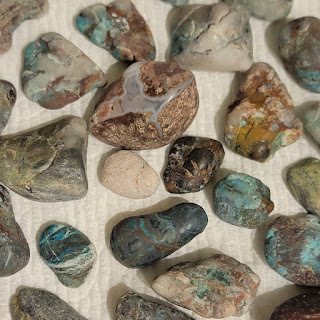
Tumbled Copper Ore stones
Tumbled Copper Ore Stones


The Environment Plays a Huge Role


Several factors control what minerals form and where:

- pH: Slightly acidic conditions help break down primary sulfides.
- CO₂ availability: Needed to form carbonate minerals.
- Water movement: Transports dissolved ions.
- Silica presence: Essential for chrysocolla.
- Time: These reactions play out over thousands to millions of years.


Final Thoughts

Whether you’re studying geology, hoarding rocks like a caffeinated prospector the way I do, or just out in your 4x4 trying not to get stuck in a wash, Arizona’s copper story is everywhere. It’s scrawled across road cuts, whispered through ghost towns, and practically winks at you from every piece of jewelry at a roadside stand.

So next time you're bouncing down a dusty trail and spot a bright green or deep blue rock, don’t just kick it aside — that could be a chunk of malachite with a better backstory than your Jeep (prove me wrong). Around here, even the rocks have history, and some of them probably have ghost town gossip to spill.


arizona state outline with rock hammer printed on hat
Arizona State Geology Hat

arizona state outline with rock hammer t-shirt for geology lovers
Arizona State Geology T-Shirt

arizona state outline with rock hammer sticker for geology lovers
Arizona State Geology Sticker

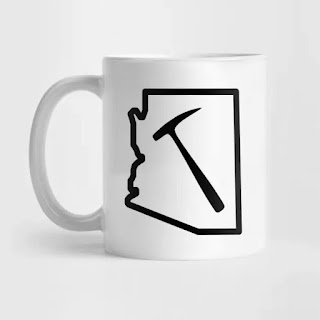
white coffee mug with arizona state silhouette with geology rock hammer
Arizona State Geology Coffee Mug


Thursday, January 9, 2025

Prehnite - The History of a Beautiful Green Mineral


Prehnite


Every time I get a new rock, I want to learn as much as I can about it.  That usually leads me down a rabbit hole of history, geography, or some other subject that I think I have no interest in... until I start doing the research.

Prehnite is my latest obsession.  I acquired some specimens of this beautiful translucent green mineral, and learned the basic geological characteristics:

-Hardness:  6.5

-Color:  Green, also sometimes yellow, white, pink, or blue

-Luster:  Vitreous - pearly

-Streak:  White

-Formula: Ca2Al2Si3O10(OH)2 a calcium aluminosilicate hydroxide mineral 

I also read that it was was first "discovered" in 1788 by someone named A.G. Werner, who named the mineral after a Dutch military Colonel, Hendrik Von Prehn.  I wanted to know these people.  

Since I don't have a working time machine, I had to rely on written data that's been passed down by people who actually did know them, over 200 years ago.  

It seems that this A.G. Werner is actually Abraham Gottlob Werner, the German "Father of Geology", who lived from September 25th, 1750 to June 30, 1817.

Werner was born into an iron mining family and worked with his dad for a few years, but in 1775 he became a teacher at the Freiburg School of Mining, where he worked for decades. He helped this school grow famous, and the Freiberg University of Mining and Technology still exists today as the "oldest mining school in the world".  

He wrote journal entries, was an excellent speaker, and became an inspiration to many.  Several of his students went on to be great European geologists.  

One of his theories was Neptunism, the scientific idea that all rocks precipitated out of water when Earth was covered by oceans.  We now understand that rocks form in many different ways, and precipitation is just one of those ways.

Werner was not a traveler, however.  Perhaps he never even left Saxony.  

...Which implies that someone would have had to bring this unidentified mineral specimen to Werner to examine.

Introducing Colonel Hendrik Von Prehn (1733 - 1785)!  He was stationed at the Cape of Good Hope, Cape Province, South Africa, where he initially found the mineral.  He was born in South Africa, but went to Holland for school.  He joined the army there, and quickly moved up the ranks.  

Prehn was also interested in science.  He even introduced a zoologist from Captain James Cook's expedition to a naturalist he knew who was visiting from Sweden.  He was a smart guy who spoke three languages.  Unfortunately he passed away while on a trip in Germany.  

Prehnite is believed to be the first mineral from South Africa that was named, and and the first mineral to be named after a person.

I can't help but wonder what it was like to travel then... before the modern conveniences of airplanes and internet maps.  

If you could hide away in a barrel on a ship to listen to the conversations, would you do it?

Now that you know the the history surrounding this fabulous mineral, add a beautiful piece of Prehnite to your rock and mineral collection here:  

Shop Prehnite Specimens and More


Thursday, November 28, 2024

Top 10 Gifts for Rockhounds and Geology Lovers

Top 10 Gifts for Rockhounds and Geology Lovers

If you're looking for a gift for the geology lover or rockhound in your life this holiday season, check out this list of the top 10 gifts for rockhounds. This list could be much longer, because there are many more things I keep in my rock bag for my outdoor adventures, or my garage at home, but let's keep it simple.  If you need more recommendations, feel free to drop me an email!  


1.  Number 1 is the most obvious gift to give anyone who loves going on rock hunting adventures.  If your rockhound doesn't have a rock hammer, get them one today!  I think Estwing hammers are the best rock hammers available, used by both amateurs and professional geologists.  My absolute favorite is the Estwing 13 oz rock pick.  The front is all hammer, for breaking, crushing, and beating.  The back has a super sharp spiky tip, for more delicate scraping or prying.  If you're looking for an extra heavy duty rock hammer, this style is also available in a 24 oz size.  My second rock hammer of choice, which is pretty worn down now from years of use, is the all purpose Estwing 14 oz geology hammer.  It has a wider, more classic tip on the back.  


2.  If they already have a rock hammer, a UV light is an important tool for finding and identify certain types of rocks.  Fluorite is often bright blue under 365nm UV light.  Calcite will often fluoresce red. Those two examples are just the beginning. Fluorescent mineral collecting can become a fun hobby by itself.  There are many UV lights, with prices ranging from pretty cheap to extra expensive.  My favorite UV lights are these two, by Alonefire and Convoy (see my blog post on UV lights for a detailed breakdown of the differences between the two).  


Fluorite under 365nm UV light


3.  A handy field guide or book about rocks and minerals is another must have for any rock collector. While the internet lets us look up just about anything in a matter of seconds, it's always good to have a real book to reference, especially if you have no cell phone signal, or if you've dropped your phone down a mine shaft while exploring an old tailings pile (true story).   National Geographic has never let me down.  For more state specific locations, the books by Dan R. Lynch are excellent. 


4. If you have access to a location known for gold, a gold pan is a fun tool to try out.  Freezing, knee deep in a California river, I remember the first piece of gold I found that was big enough to pick out of my gold pan with my fingers.  A lot of sand and gravel has been panned without finding anything, however.  If you aren't sure where to look for gold in the wild, there are pay dirt bags that you can order and pan in your backyard.  Learning to pan in your backyard is also a fun way to get the hang of it and perfect your technique. 


5.  Learning how to polish rocks with a rock tumbler can be challenging at first (I'm still learning), but is a rewarding process.  Tumbled rocks can be made into jewelry or displayed anywhere, and doing it yourself is a great way to understand how the geological concept of erosion works.  The time it takes to polish rocks might seem long, but when you think about the nature processes stones go through to get smooth, it's pretty fast.


6. A good multitool is a great gift for anyone, because it's so useful!  My favorite is the Leatherman Skeletool.  The pliers on it have removed countless cactus spines from from my back, my shoes, my hands, and many other places.  That's just a reality of wandering around in the desert.  The Skeletool is super lightweight yet sturdy, and it can be clipped on your belt loop or a backpack.  It has great knife and screwdriver bits.  This tool has saved my butt many times.  


7.  Every outdoor adventurer needs a great pair of hiking boots or shoes to get to the rock hunting sites, because everyone knows you can't just drive up to the best locations. Whether you wear men's or women's shoes, the Merrell Moab 3's are the top choice for comfort and durability.  I've been wearing Merrell shoes for years, for work and play, sometimes up to 40,000 steps per day.  They stand up to the harsh desert terrain here in Arizona, and are amazing for work where I'm on my feet, walking around all day long. These are my 3 pairs from the last 7 or so years.  


8.  If your rock collecting friend is all set for their outdoor adventures and doesn't need anymore tools, a shirt, hat, mug, or sticker can help them show off their love for rocks and minerals everywhere they go.  These designs and many more are available on t-shirts, hoodies, and other items on Redbubble or TeePublic.  


9.  Anther popular gift for people who love rocks is a crystal necklace.  Wire wrapped stones and jar necklaces add a touch of personality to any outfit.  Here are a few unique pieces of handmade jewelry that would look good on any geology lover.  Each pendant shown below offers free shipping.   


10.  Finally, the thing you can never go wrong with when shopping for a rock collector, is more rocks!  Especially interesting are rocks that they can't find near their home, or special types of minerals they don't yet have in their collection.  They will be so excited to tell everyone that their sister, brother, mom, dad, or friend got them rocks for Christmas, their birthday, graduation, or any other special occasion or holiday.  While Grumbly Tumbleweed has some cool rocks for sale, Desert Snail Minerals has a far better selection. Here are just a few: 


Sunday, September 29, 2024

What is the best 365nm UV flashlight for rocks and minerals?


What is the best 365nm UV flashlight for rocks and minerals?  


With the days getting shorter and the nights getting longer, you might be ready to go on some geology adventures after dark.  If so, are you considering buying a UV light to help find those bright fluorescent rocks and minerals?

With so many choices out there, it can be confusing to pick the UV light that's right for you.

Warning:  collecting fluorescent minerals can become addictive and lights can get very, very expensive.  I'm not going to go into details about lights for rock cabinets and home displays, or professional field lights.  These are basic lights for the rock collecting hobbyist.  

I've narrowed it down to two choices:  the Alonefire SV003 and the Convoy C8+.

Both emit a 365 nm wavelength, which is far better than many UV flashlights found at stores, which generally have a wavelength of 395 nm. 

At 365 nm, there is less light that is visible to people.  Objects, like rocks, will appear to fluoresce more.

These two pieces of fluorite will be our models.  The larger rock is from the Silver District in La Paz County, Arizona.  The smaller one is from the 3 Clowns Pocket near Oatman, Arizona.


This picture was taken shining the Alonefire SV003 UV flashlight on the rocks.  

Pros:
-Smaller, at only 4.69" long, which makes it easy to throw in a pocket or small compartment of your rock bag  -It is also much cheaper than the Convoy C8+
-Comes with rechargeable battery

Cons:
-Not as bright.  Up close it's great, but for any distance it's kind of dim


This photo was taken shining the Convoy C8+ flashlight on the rocks.  

Pros: 
-More powerful, and can fluoresce things up to 80 feet away
-Has a glass filter to absorb even more visible light
-Waterproof  

Cons:
-Larger, 9.8" long, making it bulkier to store in small places like pockets  
-Expensive, more than twice the price of the Alonefire


Both lights do a fantastic job showing the fluorescence of these beautiful fluorite samples.

My vote is for the Alonefire SV003.  It fits conveniently in the mini side compartment of my rock bag.  If I'm walking around the desert at night, I can still find fluorite and other fluorescent rocks and minerals near my feet and a short distance in front of me.  Sometimes I even light up an unsuspecting scorpion.  For the price, I don't have to worry about being too delicate with it.

Those on team Convoy C8+ might be able to light up the rocks and minerals in the next county, maybe.  Or, if water is a factor in your rockhounding expeditions, it might be a better light to consider.  However, to me the size and price just aren't worth it.  


Monday, August 5, 2024

I Like Rocks...

I like rocks. 

I started bringing them home as a kid in Wisconsin and earned the nickname "Rocky" from my parents. 

There were rocks in the yard, rocks in the house, rocks in the car, and rocks in my pockets. They came from the playground, the grocery store parking lot, my friends' yards, and the side of the road.

Soon I found out that you could even buy fancy rocks at the mall and in tourist town gift shops.

Since then, I've learned a lot about rocks, and how to collect them responsibly. I minored in Geology at the University of Wisconsin, Milwaukee, took some classes at Arizona State University, and froze my butt off when it snowed at field camp in the desert. 

As I mentioned earlier, there will be rocks and minerals, crystals, and other schist in this blog. Some will probably be for sale, some I won't be able to part with, and some probably won't even be mine. 

You've been warned...

Here is a midnight photo of the rock cabinet in my living room:


I also create designs and geology gifts for people like me who like rocks on t-shirts, hats, tote bags, hoodies, and more.  Here's one I made.  Tell me what you think of it, or click the link below to shop!


Suggested Posts