Quartz is everywhere. It sparkles in geodes, hides in sedimentary layers, hardens in metamorphic rocks, and generally refuses to mind its own business. Because it shows up in so many forms, people tend to use words like quartz, chalcedony, agate, and jasper interchangeably. This is understandable, since they are all the same chemical formula. It is also slightly maddening if you enjoy accuracy or have ever tried to explain rocks to a friend who insists their beige driveway gravel is really made of amethyst.
So, let's figure it out. ...Or stop reading here and just call it all quartz. You won't technically be wrong.
The Quartz Family Tree
Quartz comes in two major structural styles:
big crystals you can see and tiny crystals you cannot, no matter how hard you squint.
Same chemistry, different architecture, different capacity for causing arguments at gem shows.
 |
| Macrocrystalline Quartz |
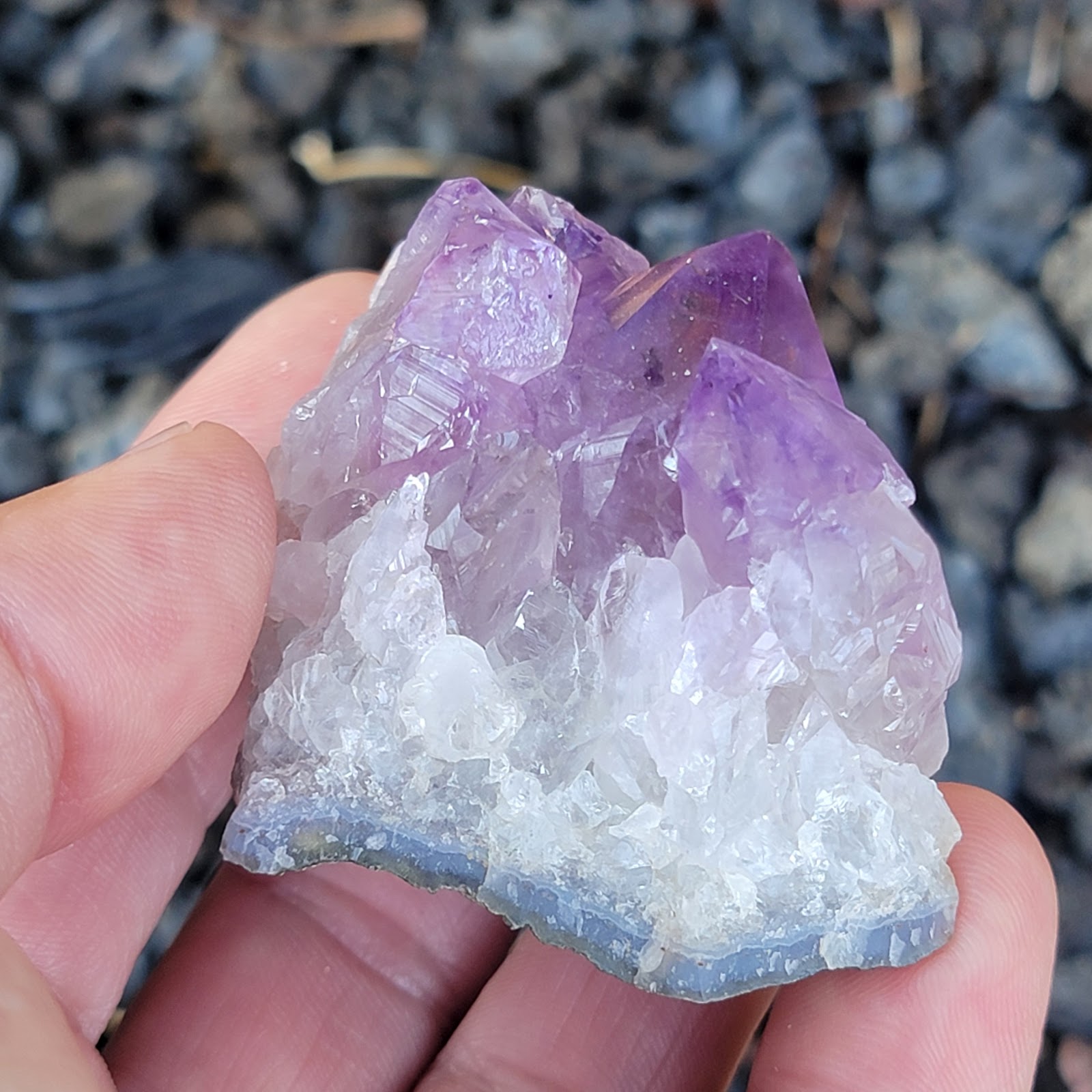
1. Macrocrystalline Quartz
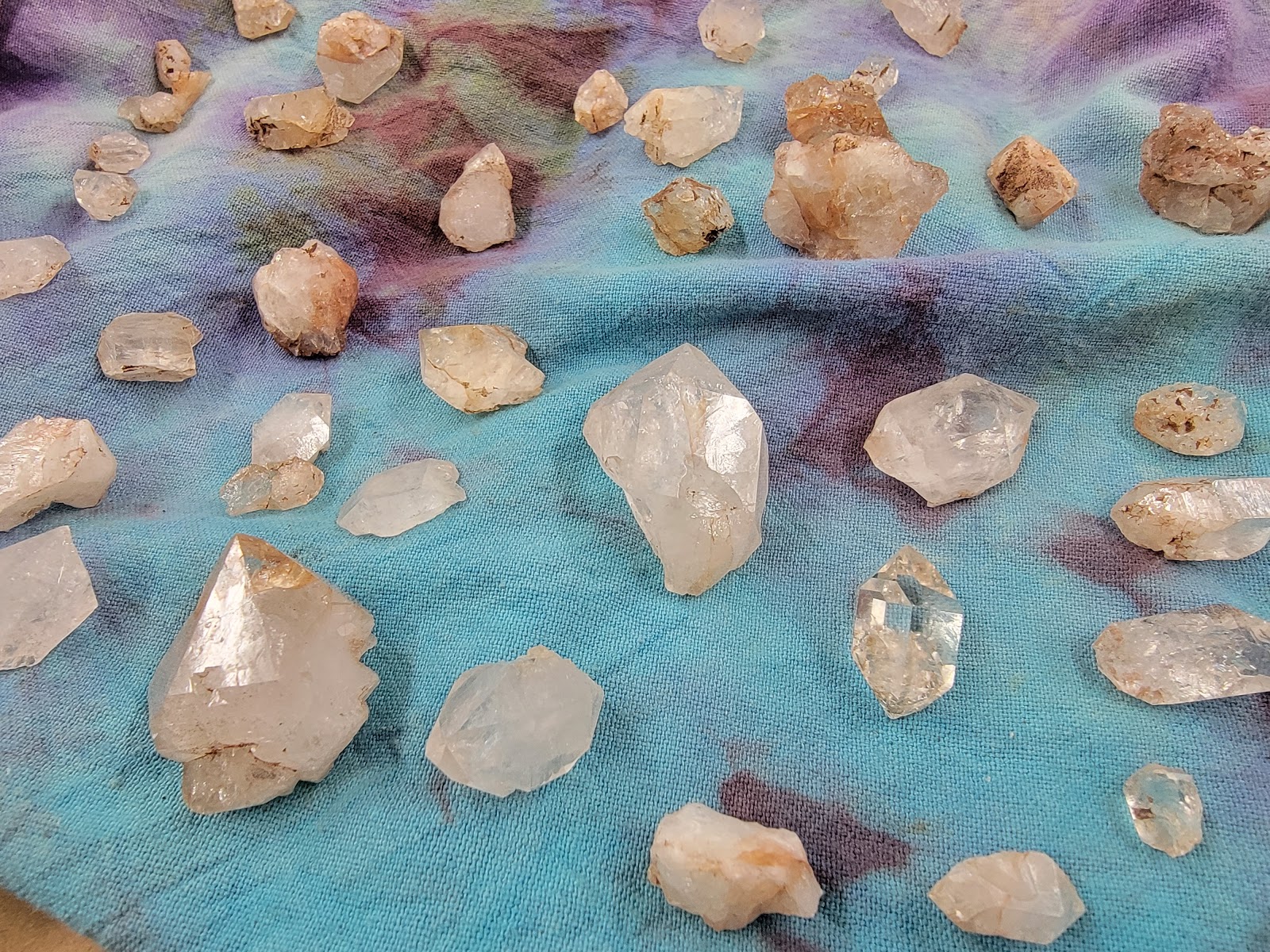
These are the large, visible crystals that grow in open spaces and look very pleased with themselves. They tend to be the celebrities of the quartz world.
Common examples:
• Rock crystal: clear and painfully honest
• Amethyst: purple and perpetually popular
• Citrine: yellow to orange, sometimes roasted from amethyst
• Smoky quartz: gray to black from natural radiation
• Rose quartz: pink from microscopic inclusions that refuse to identify themselves
And then there is drusy (or druzy) quartz, which is what happens when quartz decides to grow thousands of tiny crystals across a surface instead of one big dramatic prism. Think of it as quartz confetti stuck to the rock, the way glitter sticks to your car seat after a night out at the uh... craft show. Drusy forms along cavity walls, cracks, or vugs, coating them with glitter-like microcrystals that look fancy but are really just quartz showing off in bulk.
These macrocrystalline varieties typically form in hydrothermal veins, pegmatites, and geodes. Think of them as quartz with plenty of elbow room... or at least as much as they'd get on a flight to Los Angeles.
 |
| Cryptocrystalline quartz |
2. Cryptocrystalline Quartz (The Chalcedony Group)
Here the crystals are so tiny they behave as a single mass. A microscopic intergrowth of quartz and moganite gives these varieties their waxy to dull luster and a mildly secretive personality.
This group includes chalcedony, agate, and jasper, all of which are essentially quartz that refused to grow big crystals like its flashier siblings.
 |
| Botryoidal chalcedony |
Chalcedony: The Smooth Operator
Chalcedony is translucent, evenly colored microcrystalline quartz. Pale blues, grays, and soft whites dominate, though trace elements or dyes can take it into wilder territory.
It forms from silica-rich groundwater or low-temperature hydrothermal fluids. Its fibrous structure gives it a silky or waxy sheen, perfect for jewelry.
Chalcedony often forms pseudomorphs, replacing shells or fossils one microscopic layer at a time. Nature is nothing if not patient.
Look for: uniform color, soft translucence, and a smooth, waxy surface.
 |
| Agate rock specimen |
Agate: The Banded Beauty
Agate is chalcedony with a flair for dramatic layers. It forms when silica-rich fluids deposit rhythmic bands inside volcanic cavities. Each band reflects a tiny geological mood shift, because even rocks have days when they feel stripe-y. (Science is still working on proving that, probably... maybe?)
Varieties include:
• Moss agate: plantlike inclusions that are absolutely not plants
• Onyx: straight black and white layers for the minimalist purist
• Lace agate: swirling, ornate patterns that suggest Earth briefly decided to doodle
Agate is essentially a layered geological diary. Some entries are profound. Others are essentially: I was a lava bubble once, and here are thirty-seven bands, like songs I wrote about it.
 |
| Jasper rock specimen |
Jasper: The Earthy Artist
Jasper is another form of chalcedony but opaque, thanks to abundant mineral inclusions. These inclusions scatter light and create wild patterns. Iron oxides supply reds, yellows, and browns, while other minerals add greens or grays.
Jasper commonly forms when silica-rich fluids cement or replace sediment. If the stone looks like an abstract painting or a miniature landscape, it is probably jasper.
In summary:
• Agate: translucent, banded
• Jasper: opaque, patterned
Both: chalcedony
All: quartz
Result: limitless gem show debates
Other Members of the Quartz Clan
• Carnelian: orange-red chalcedony that looks permanently sunburned
• Sard: carnelian’s darker, moodier sibling
• Bloodstone: green chalcedony with red jasper spots for dramatic flair
• Aventurine: quartz with mica, proudly glassy looking, usually greenish
• Chert and flint: fine-grained silica that once made excellent tools and now mostly makes confusion
• Tiger’s eye: quartz replacing fibrous amphibole, resulting in a suspiciously shimmery surface when polished
• Drusy quartz: mentioned above, but worth repeating because people love anything glittery, even when it is totally just a boat load of tiny quartz crystals doing their best impression of sugar frosting
Quartz Family Comparison Table
| Type | Crystal Size | Transparency | Key Features | Typical Formation |
|---|---|---|---|---|
| Quartz (macrocrystalline) | Large, visible | Transparent to translucent | Distinct crystals, glassy luster | Hydrothermal veins, pegmatites, geodes |
| Chalcedony | Microcrystalline | Translucent | Smooth, even color, waxy surface | Silica-rich fluids filling fractures |
| Agate | Microcrystalline (banded) | Translucent | Rhythmic bands, concentric layers | Layered deposition in volcanic vesicles |
| Jasper | Microcrystalline (impure) | Opaque | Heavy inclusions, wild patterns | Silica replacing or cementing sediment |
Geologist’s Quick Reference: Quartz Varieties
| Stone | Structure Type | Transparency | Common Colors | Formation Environment | Key Clues |
|---|---|---|---|---|---|
| Quartz (macrocrystalline) | Visible crystals | Transparent to translucent | Clear, purple, yellow, pink, smoky | Hydrothermal, pegmatitic | Glassy luster, hexagonal prisms |
| Chalcedony | Microcrystalline, fibrous | Translucent | Gray, white, pale blue | Groundwater silica deposition | Waxy luster, even color |
| Agate | Layered chalcedony | Translucent | Multicolored banding | Volcanic vesicles | Concentric or wavy bands |
| Jasper | Impure chalcedony | Opaque | Red, brown, yellow, green | Sedimentary replacement | Earthy patterns, dense texture |
| Carnelian / Sard | Iron-stained chalcedony | Translucent | Orange to reddish brown | Low-temperature hydrothermal | Warm colors, even tone |
| Bloodstone | Chalcedony with hematite | Opaque to translucent | Dark green with red spots | Hydrothermal or volcanic | Red dots on green background |
| Aventurine | Quartz with mica | Translucent to opaque | Green, brown | Metamorphic | Sparkly aventurescence |
| Tiger’s eye | Quartz pseudomorph | Chatoyant | Golden brown | Silicified amphibole | Fibrous shimmer |
| Drusy (Druzy) Quartz | Microcrystalline coating | Sparkly surface | Usually clear or white | Cavity walls, fractures, vugs | Tiny glitter-like quartz crystals covering a matrix |
If someone says quartz is simple after all this, hand them these charts and watch their confidence weather faster than a freshly exposed outcrop during monsoon season.
If you're looking for some awesome quartz crystals, chalcedony specimens, or other rocks and minerals... even if they aren't quartz, I understand. Find great specimens and geology gifts at https://www.grumblytumbleweed.com or in my Etsy shop.