Blog Archive

Showing posts with label rock. Show all posts

Monday, March 17, 2025

The Geology of Kyanite: A Unique Metamorphic Mineral

The Geology of Kyanite: A Unique Metamorphic Mineral


Kyanite is a fascinating mineral with distinct geological properties that make it highly valuable for both scientific study and industrial use. Known for its striking blue color—though it can also appear green, gray, or even colorless—kyanite forms under specific pressure and temperature conditions in metamorphic rocks. Its unique crystal structure and physical properties set it apart from other minerals, making it an important indicator of geological processes.


Formation and Occurrence

Kyanite is an aluminosilicate mineral with the chemical formula Al₂SiO₅. It forms in high-pressure, low-temperature metamorphic environments, typically in schists and gneisses derived from clay-rich sedimentary rocks. These rocks undergo regional metamorphism, where intense heat and pressure cause minerals to recrystallize and transform into new structures.

Kyanite is one of three polymorphs of Al₂SiO₅, along with andalusite and sillimanite. These minerals have the same chemical composition but different crystal structures, which develop based on varying temperature and pressure conditions. Kyanite forms under high-pressure conditions, while andalusite and sillimanite are stable at lower pressures and higher temperatures, respectively. Geologists use the presence of these polymorphs to interpret the metamorphic history of rocks.

Physical Properties

One of kyanite's most distinctive characteristics is its anisotropic hardness—meaning it has different hardness values depending on the direction of measurement. Along its length, kyanite has a hardness of about 4.5–5 on the Mohs scale, but across its width, it measures around 6.5–7. This property makes kyanite challenging to cut and polish, though it remains a sought-after gemstone.

Kyanite typically forms as elongated, bladed crystals with a vitreous to pearly luster. It often appears in shades of blue due to trace amounts of iron and titanium, though other colors can occur depending on chemical impurities.

Geological Importance

Because kyanite forms under specific pressure and temperature conditions, its presence in metamorphic rocks provides valuable insights into geological history. Geologists use kyanite as a metamorphic index mineral to determine the pressure-temperature conditions a rock has experienced. This information helps reconstruct the tectonic environments where the rock formed, such as deep continental collisions or subduction zones.

Kyanite Bottle Necklace, for Sale on Etsy


Industrial and Gemological Uses

Beyond its geological significance, kyanite has important industrial applications. Due to its high heat resistance, it is used in refractory materials, ceramics, and foundry molds. The mineral is also a key component in the production of heat-resistant porcelain and spark plugs.

In the gemstone market, kyanite’s deep blue color and unique sheen make it a popular, though relatively fragile, choice for jewelry. Because of its anisotropic hardness, lapidaries must carefully cut kyanite to avoid breakage.

Notable Deposits

Kyanite is found worldwide, with significant deposits in:

Brazil – Known for high-quality blue kyanite crystals used in jewelry.

United States (Virginia, Georgia, South Carolina) – Major producers of industrial-grade kyanite.

Switzerland, Russia, India, and Nepal – Other notable sources.


Conclusion

Kyanite is a remarkable mineral that bridges the fields of geology, industry, and gemology. Its formation under specific metamorphic conditions makes it a valuable tool for understanding Earth's history, while its unique properties make it indispensable in high-temperature industrial applications. Whether studied under a geologist’s lens or admired in a piece of jewelry, kyanite remains a mineral of great scientific and aesthetic interest.

Shopping


Interested in natural rough Kyanite rock specimens or Kyanite jewelry?  Shop for Kyanite and other rocks, minerals, crystals, and jewelry on Etsy or Ebay.  


Wednesday, February 19, 2025

What's the difference between a crystal, a mineral, and a rock?


Rocks, minerals, and crystals...

We often use the terms interchangeably.  

I don't tell my friends I'm going to look for minerals.  It sounds... so technical.  I say, "I'm going to look for rocks."

"I found a big crystal!" is usually said with more enthusiasm than, "I found a big rock!"

So, what exactly is the difference between rocks, minerals, and crystals?  Let’s do a really quick breakdown of the terms and explore the fun world of geology together.  

We'll examine how each is formed, and what we use them for in our world.

1.  Crystals

Here we have fluorite crystals, pyrite crystals, and wulfenite crystals.

Crystals are solids that have it all together.  You know, like the guy in accounting who's car is always spotless, even after it rains, or the chick who got to work 30 minutes early just to organize her toolbox, again!?  Ugh. 

Imagine tiny atoms or molecules, all arranged neatly in an organized, repeating pattern - called a crystal lattice. This meticulous arrangement gives crystals their unique geometric shapes, symmetry, and special physical properties. 

For example, crystals naturally take on distinct shapes like cubes, hexagons, or even pyramids.  

Each type of crystal boasts its very own specific chemical formula that explains its composition. Look at a quartz crystal: SiO2, or silicon dioxide. That tells you it's made up of silicon and oxygen atoms.

Crystals can be found in nature (like quartz, but also think diamonds or salt) or even created in a lab (like some gemstones). 

What might seem odd to rockhounds, is that not all crystals are minerals. For example, sugar and ice can also form beautiful crystals but won't count as minerals. 

Crystals form through the same processes whether in nature or in labs:

 - Cooling Liquids:  Crystals can form when liquids cool down, like quartz from magma or salt from seawater.

   - Precipitation from Solutions:  This happens when minerals become too saturated in a liquid and solidify, like the sugar crystals that form in syrup.

   - Sublimation from Gases:  Some minerals can even form directly from volcanic gases, such as those beautiful but smelly sulfur crystals.

Crystals look awesome on our display shelves, but check out what else we can do with them: 

- Technology:  Quartz crystals help keep time accurately in watches, radios, and other electronic devices.

   - Medical Applications: Crystalline structures are used in medications and medical imaging technologies.

   - Spiritual & Healing Practices:  Many people believe in the special properties of crystals for meditation and alternative healing.


Tourmaline crystal necklace

   - Food & Preservation: Salt, a crystalline mineral, is essential in cooking and preserving food.

For a nerdy bonus, let’s dive into the different types of crystals (feel free to skip this if you're not THAT into crystals).

- Ionic Crystals: These are formed by the attraction between positive and negative ions, like table salt (NaCl).

- Covalent Crystals: Here, atoms bond in a continuous network, examples include diamond and quartz.

- Metallic Crystals: These consist of metal atoms that have free-moving electrons, like gold and copper.

- Molecular Crystals: These are held together by weaker forces, such as Van der Waals forces, like ice and sugar.


2. Minerals

Looking for unique minerals or gifts for a rock lover?  Click here.

Now, let’s talk about minerals! These are naturally occurring and inorganic (no plant or animal parts in here). Also, like crystals, minerals also have a specific chemical makeup (formula) and a crystalline structure. 

Remember the SiO2 crystal from just a bit ago? Quartz is a mineral too!  I knowwww... it's confusing, but just hear me out.

Heres why quartz (and many others) can be both a crystal and a mineral: All minerals have a crystal structure, but they don’t always look like perfect crystals.  


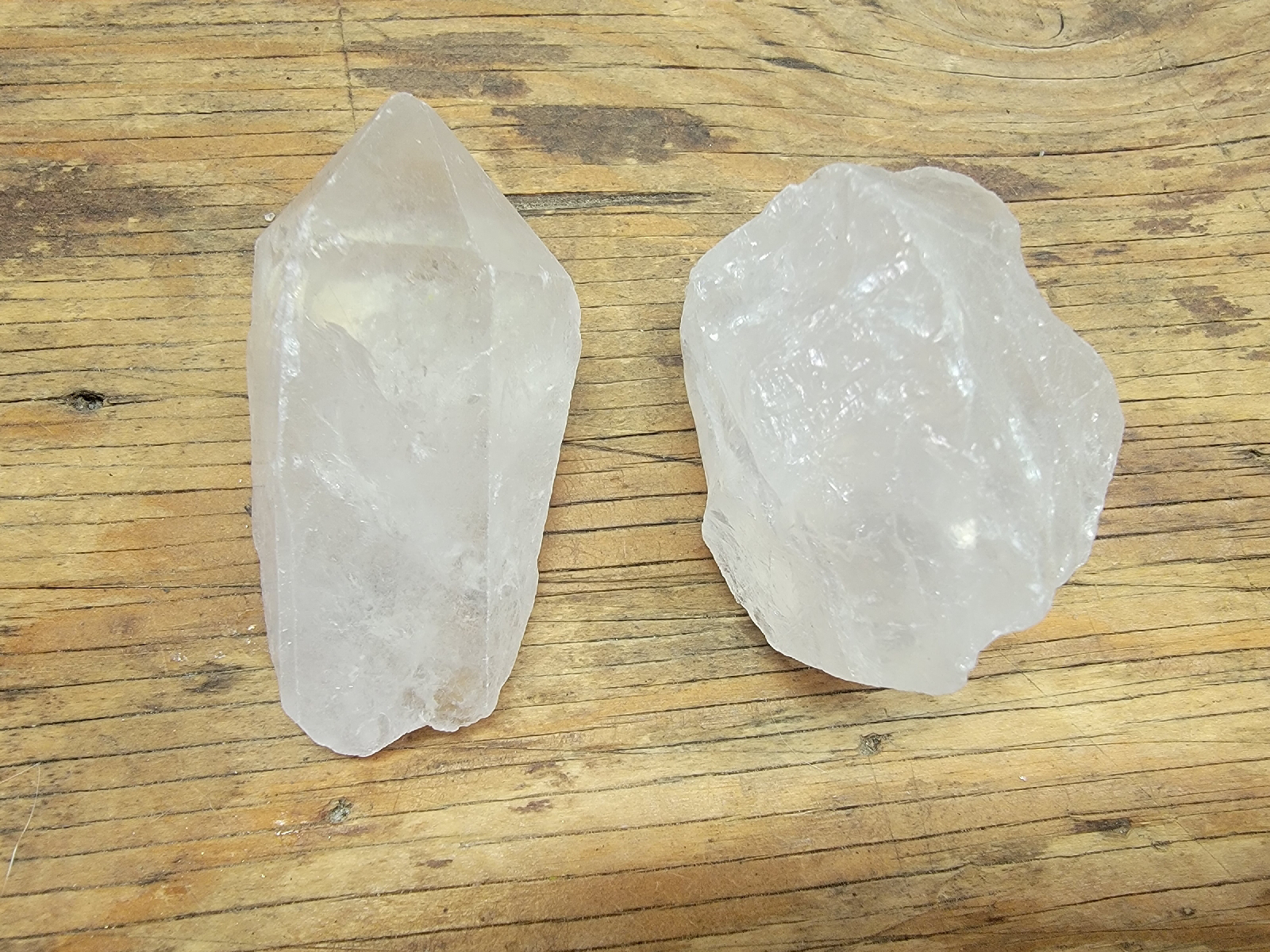
The quartz on the left has formed a crystal, while the one on the right has not. 

Think of minerals as the essential building blocks of rocks. Some other well-known minerals are calcite and mica.

Calcite is on the left, mica is on the right.

Most minerals that occur naturally can form as crystals.  Not all do because of cooling rate, space constraints, and other factors in nature. 

Minerals form through these natural geological processes:

   - Cooling Magma or Lava:  This process allows minerals like quartz and feldspar to crystallize.

   - Water Evaporation:  When water evaporates, minerals such as halite (that’s salt!) can form from the dissolved elements becoming solid.

   - Heat and Pressure:  When existing minerals are subjected to heat and pressure, their atoms rearrange to create new minerals, like graphite transforming into diamond.

Another important thing to remember is every rock is made up of minerals, but not all minerals form rocks.

It's no surprise that minerals have many of the same uses as crystals, and even more in society:

 - Industry: Quartz is vital in glassmaking, and feldspar is super important in ceramics.

   - Technology: Silicon sourced from quartz plays a crucial role in computer chips and electronics.

   - Jewelry: Luxurious gems like diamonds, rubies, and emeralds shine in jewelry pieces.

   - Health & Medicine: Calcium minerals pop up in supplements, while fluorite is an ingredient in toothpaste for keeping our teeth healthy.

3. Rocks


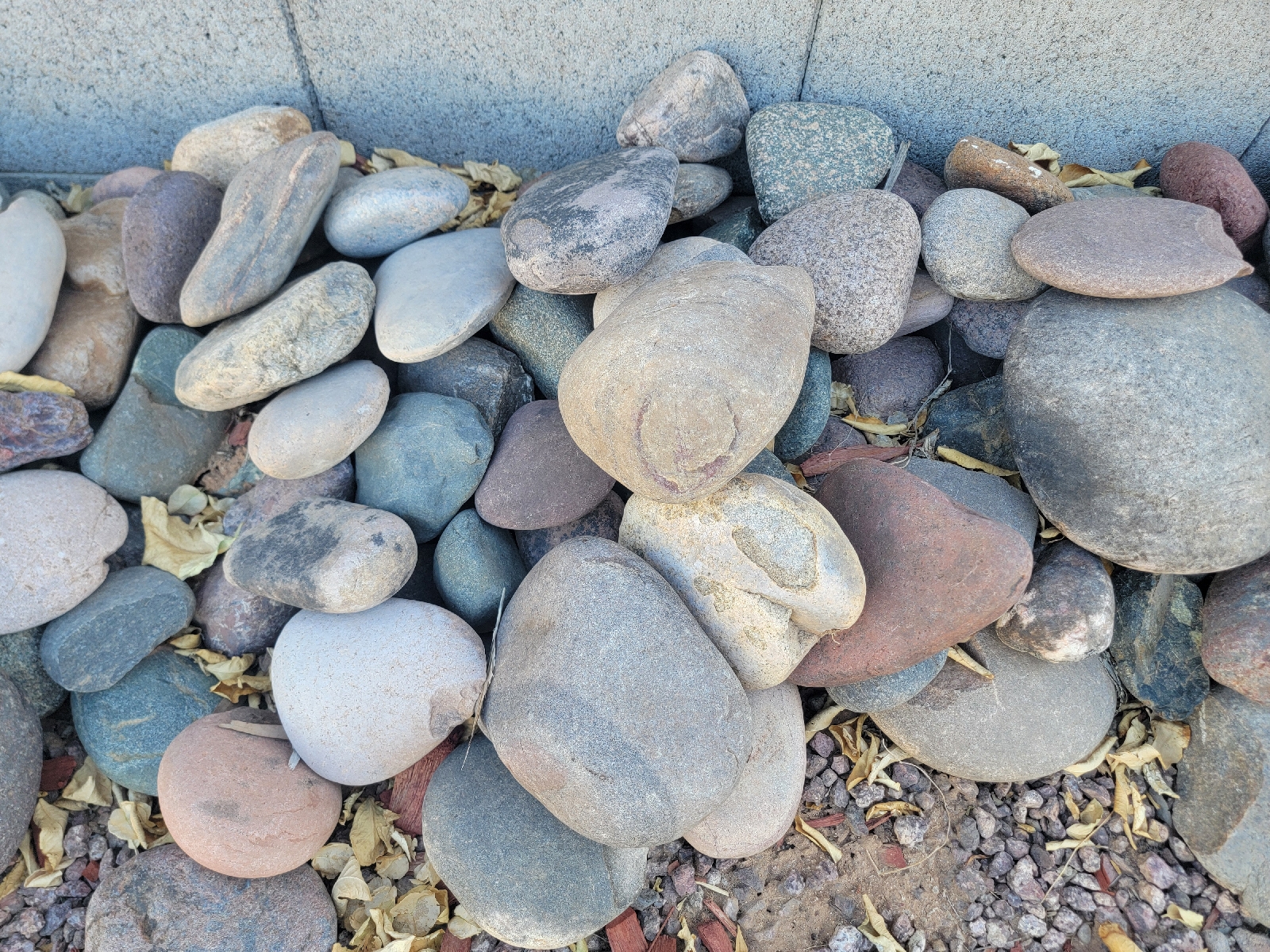
Rocks are all those other sturdy materials you find in nature, made up of one or more minerals (and sometimes even organic matter). They're the things I usually trip over while I'm out running on the trails, or the things I find in my washing machine when I forget them in my pockets (I'm sorry to all the granite I prematurely decomposed into gravel).   

Unlike minerals and crystals, rocks don’t have a fixed chemical composition. 

We can classify rocks into three main groups based on how they form:

   - Igneous Rocks:  These form when magma or lava cools down and solidifies. You might be familiar with basalt and granite.

Granite

   - Sedimentary Rocks:  These happen when layers of sediments (think sand, silt, clay, or even organic material) gather and get compressed over time, giving us limestone and sandstone.

Limestone with a fossil

   - Metamorphic Rocks:  Existing rocks go through intense heat and pressure and change their structures. Marble, which comes from limestone, and schist are great examples.

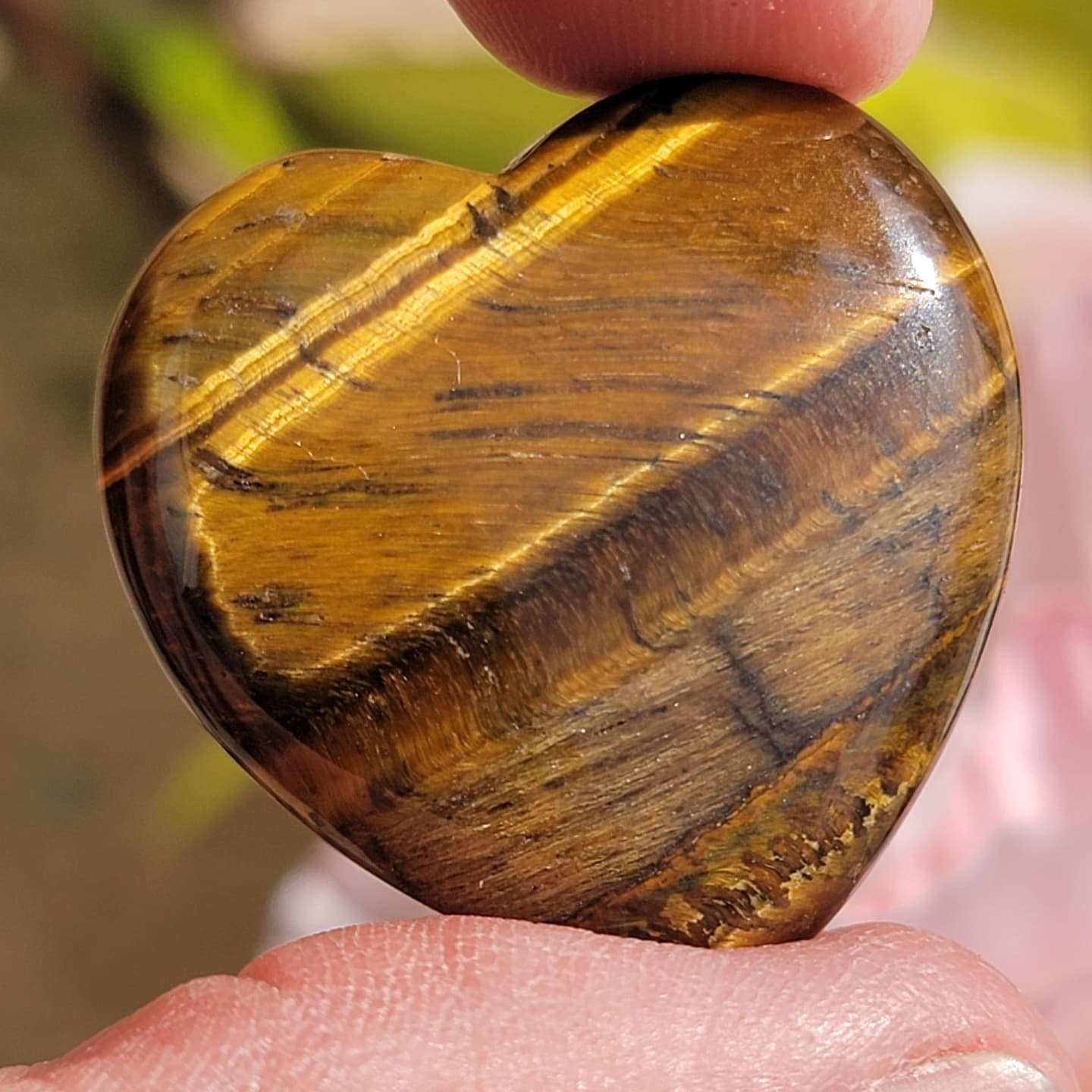
Tigers eye is a polished metamorphic rock.

Just take a look around, and you'll see rocks being useful to people who don't even like them, aww:

- Construction:  Strong materials like granite, limestone, and sandstone are popular choices for building roads, monuments, and more.

   - Decoration:  Marble is a go-to for elegant sculptures and stylish countertops.

   - Energy Production:  Coal, which is a sedimentary rock, is burned to help generate electricity.


In case you scrolled down just for the pictures, read this and you can pretend you read it all! 

To sum it up, rocks consist of various minerals and are categorized based on their formation methods. Minerals are naturally occurring with a specific chemical structure and crystalline form, while crystals feature a highly organized atom arrangement. Each of these plays a vital role in both nature and our daily lives, contributing to everything from construction and technology to health and wellness!

Monday, November 4, 2024

What is Limonite after Pyrite?


It's kind of like a pyrite cube, but it looks all rusty or something... what the heck is it?!

Meet limonite after pyrite, a handsome little pseudomorph.   

A long time ago, golden colored pyrite cubes were happily existing, as rocks and minerals do... and along came some extremely hot water, most likely the rude sidekick of a local igneous intrusion. 

This hydrothermal activity chemically changed the pyrite forever, replacing the iron sulfide with a mixture of hydrated iron oxides.    

Stunning examples of limonite after pyrite can be found in many locations across the globe.

This particular rock specimen is from the Harquahala Mining District in La Paz County, Arizona.  

To see more pictures of this limonite after pyrite and other unique rocks and minerals, as well as handmade rock jewelry and geology themed gifts, please visit my Etsy shop.


Friday, August 9, 2024

What is Chrysocolla?


Rocks are kind of like people.  Each one has its own personality and characteristics.  Let's get to know chrysocolla today. 


With its bright blueish green color, it stands out in a crowded box full of granite and sandstone.  

It's actually found in many different shades.  Get out your crayons and find the ones labeled teal and cyan. If you've got the fancy Crayola box, check out Robin Egg Blue, Shamrock, and Blue Green. If you've graduated to Behr paint samples, think Key Largo or Island Dream, and, well you get the idea.  However, chrysocolla can even be black or brown.

The Hardness of chrysocolla ranges from 2.5 - 7, depending on the amount of silica in it. Generally dark blue has less silica and is softer, light blue has more silica and is harder.

Here is the basic chemical formula of Chrysocolla: 

 Cu2H2Si2O5(OH)4

However, there is also a more complicate formula, because the composition of chrysocolla can vary:   

(Cu2-x,Alx)H2-xSi2O5(OH)4 · nH2O  where x<1

That means chrysocolla has copper, aluminum, hydrogen, silicon, and oxygen in it.  It is a secondary hydrous copper phyllosilicate mineral.

Wait, a who what now? 

Secondary minerals are formed when another mineral is altered.  Chrysocolla is found in the oxidation zones of copper deposits, where water with dissolved silica (SiO2) in it attacks the copper and causes it to decompose.  

Hydrous means that it has water molecules (H2O) in its structure, since water played a factor in the formation of the mineral. 

A silicate mineral is one that forms when a negatively charged silicon (Si) and oxygen (O) anion combine with a metal ion, like copper or aluminum (Cu, Al).

Phyllosilicate is a fancy word for sheet silicate, meaning it forms in layers, the structure is based on connected rings of silicon and oxygen that extend outward in infinite sheets. 

You won't find any defined chrysocolla crystals.  It forms in masses and crusts, fills veins, and sometimes looks like a bubbly botryoidal blanket covering the surface of a rock.  

If you're curious about the metaphysical properties of chrysocolla, I've heard it's a calming stone that inspires creativity and has a long list of other healing properties.  

I lost the chrysocolla necklace that I wore for years. Ironically, I think it's in a mine, but I'm not sure.  If I knew exactly where I lost it, I'd go back and find it. I was not calm at all when I found out it was gone, and I bet it was pretty distraught too, but I'm no expert on emotional crystals or rocks with feelings.  The internet has many resources if you want to know more about that topic.

However, if you're interested in adding a new chrysocolla specimen to your rock collection, I can help you with that.  These are a few that are available in my Etsy shop now, or feel free to message me if you'd like to see more that I haven't listed yet.  


Suggested Posts